
Event: 2026 FIFA World Cup
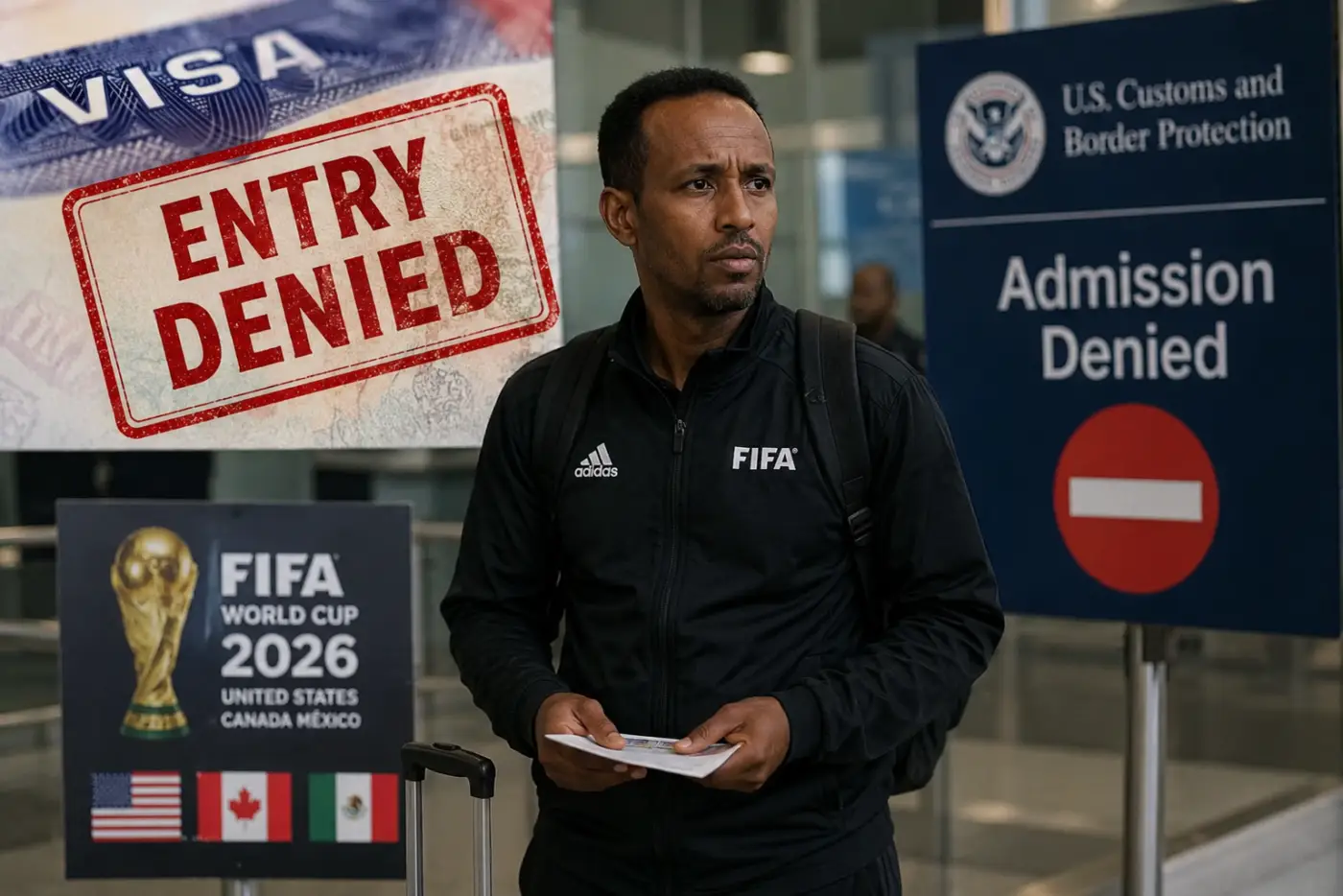
Somali referee Omar Abdulkadir Artan has reportedly been denied entry into the United States, dealing a major blow to his hopes of officiating at the 2026 FIFA World Cup.
Artan, widely regarded as one of Africa’s top referees, had just arrived at Miami International Airport when U.S. immigration authorities refused to allow him into the country. He was later required to board another flight back to Istanbul, ending what could have been a historic World Cup journey.
The decision is especially significant because Artan was expected to become the first Somali referee in history to officiate at a FIFA World Cup. His selection had been seen as a major milestone not only for his personal career, but also for Somali football.
Artan was recently named Africa’s Best Men’s Referee for 2025, a recognition that highlighted his growing reputation across the continent. However, despite being selected for World Cup duties, his entry into the United States was not approved.
According to reports, the issue began after Artan arrived in Miami and was placed under additional screening by U.S. Customs and Border Protection. Following the review process, authorities determined that he was not eligible to enter the country due to concerns raised during background checks.
FIFA has acknowledged the situation but stated that it does not interfere with the immigration procedures of host countries. The organization also made it clear that final decisions regarding visas and border entry remain under the authority of the host nation.
U.S. officials reportedly informed FIFA that the decision would not be reversed. Under current rules, even individuals invited by FIFA to participate in the World Cup must still meet the immigration and security requirements of the country they are entering.
The incident has sparked strong criticism from members of the African football community. Many believe Artan’s case raises serious questions about fairness, representation, and equal access to global sporting events.
Ciise Aden Abshir, an adviser to Somalia’s Ministry of Sports, called on the international football community to defend Artan. He said the decision not only damages the referee’s personal reputation, but also undermines football’s commitment to fairness, merit, and sporting integrity.
For Artan, the situation is a devastating setback. Officiating at the World Cup is considered the highest achievement for any referee. For a Somali official, it would have carried even greater meaning, representing a historic breakthrough for the country on football’s biggest stage.
The controversy also comes as the United States prepares to co-host the 2026 World Cup alongside Canada and Mexico. With the tournament approaching, U.S. authorities have taken a firm position on border security and immigration procedures.
Reports suggest that some teams, officials, and staff from countries facing travel restrictions or additional scrutiny could encounter challenges entering the United States before or during the tournament.
As a result, Artan’s case has become one of the most talked-about controversies ahead of the 2026 World Cup. It highlights a difficult question for global sports: how can an international tournament remain fully inclusive when immigration decisions are ultimately controlled by the host country?
For Omar Abdulkadir Artan, the 2026 World Cup was supposed to be the biggest moment of his career. Instead, his dream appears to have ended at the airport gates in Miami.
 UEFA Super Cup 2026 Preview: PSG vs Aston Villa in Salzburg
  Ballon d’Or 2026 Race: Rodri Leads as Yamal, Messi and Kane Chase
  Anthony Joshua Defeats Kristian Prenga via Second Round KO – Comeback Victory Sets Up Tyson Fury Showdown
  FIFA’s World Cup Investment Plan Faces Collapse as 96 Nations Push Back
  Spain Outclass France to Reach World Cup Final as Yamal and De La Fuente’s System Shine
  Declan Rice Set to Return as England Prepare for Argentina and Messi Showdown