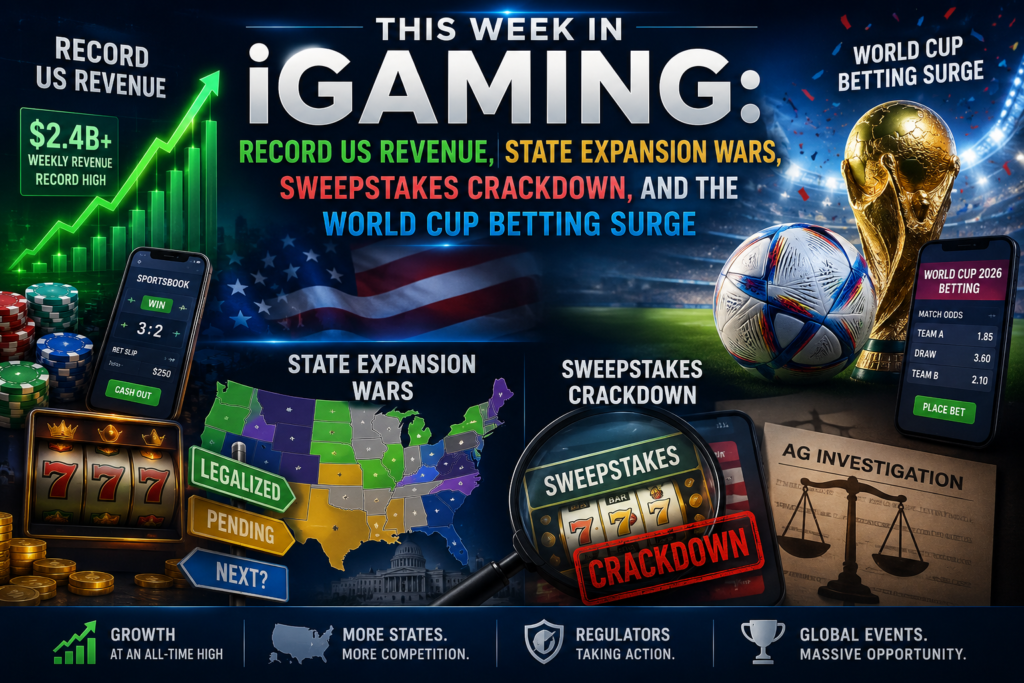
This Week in iGaming: Record US Revenue, State Expansion Wars, Sweepstakes Crackdown, and the World Cup Betting Surge
The week of May 25, 2026 arrives with a raft of significant developments across the global iGaming landscape. From a landmark revenue figure that cements the United States as the world’s fastest-growing regulated gambling market, to a tug-of-war over sweepstakes casinos that is reshaping the grey-market debate, industry observers have plenty to digest. We have also got a Canadian market in genuine transition and a summer sports betting window — courtesy of the FIFA World Cup — that analysts are calling the biggest single betting event in US history. Here is our independent editorial breakdown of the four stories that matter most right now.
At a Glance: Key Numbers This Week
| Metric | Figure | Context |
|---|---|---|
| US iGaming GGR (2025) | $10.73 billion | +27.6% year-on-year; all-time record |
| US states with legal iCasino | 7 (+ Maine pending) | NY bill advancing; could add $3–4B GGR |
| World Cup 2026 US betting handle (projected) | $3.3 billion | Deutsche Bank base-case; +2x vs Qatar 2022 |
| US adults with legal sports betting access | ~135 million | ~30% more than at the 2022 World Cup |
| States acting against sweepstakes casinos | 16+ | MS, IA, OK among those passing new restrictions |
All figures should be verified against official sources.
Story 1: US iGaming Crosses the $10 Billion Threshold — and Keeps Climbing
The American Gaming Association confirmed that total US commercial gaming revenue surpassed $78 billion in 2025, but the headline number for the online segment is what has caught the industry’s attention: iGaming gross gaming revenue reached a new all-time high of $10.73 billion, a jump of 27.6 percent compared to 2024. To put that in perspective, it took the sector almost a decade after New Jersey launched regulated online casinos in 2013 to break through the single-digit billion-dollar barrier — and the industry then added roughly a quarter of that again within a single calendar year.
The growth is concentrated in a handful of states. Pennsylvania led all markets with $3.46 billion in iGaming revenue, a near-28 percent annual increase. New Jersey — the original pioneer — remains a robust second market. Most striking is the structural shift: for the first time ever, iGaming revenue in both Pennsylvania and New Jersey exceeded the revenue generated by their respective land-based commercial casinos.
Michigan and Connecticut continue to post strong numbers, and the momentum is clearly pushing policy conversations in states that have so far kept their online casino doors firmly shut. The overall US commercial gaming total broke records for the third straight year, though prediction markets remain a contested category complicating the headline figures.
What This Means for Players
Record revenues translate into a more competitive licensing environment, which in practice means operators invest more heavily in welcome bonuses, loyalty programmes, and product depth to retain market share. Players in legal states should expect continued improvements in game libraries and promotional activity throughout 2026. Rising revenues also attract heightened regulatory scrutiny — which is not necessarily a negative development for consumer protection.
Story 2: New York, State Expansion, and the Billion-Dollar iCasino Race
The single most consequential piece of potential legislation in the US iGaming space right now is New York’s online casino bill. Albany advanced the proposal further during the 2025–2026 session than at any previous point, and if signed into law, analysts project New York would immediately become the country’s largest iGaming market — generating an estimated $3 to $4 billion in annual gross gaming revenue from day one.
New York is not alone in reassessing its position. Virginia, Hawaii, and Maine have all seen renewed legislative activity in 2026. Maine actually signed an online casino bill into law in January 2026, though the operational launch has not yet taken place. The gap between legalisation and live market is typically 12 to 24 months.
Each state has a distinct regulatory structure, tax rate, and operator licence count. Pennsylvania applies a 36 percent tax on slots revenue, among the highest in the country. New York’s final tax structure will be critical in determining how many operators choose to enter the market and at what promotional intensity.
The Competitive Landscape Ahead
Major operators including DraftKings, FanDuel, BetMGM, and Caesars Digital are already positioned to move quickly in any new state market. Players interested in which operators might launch in their state should monitor the relevant gaming control board’s website for licence applications — information that official sources publish in real time.
Story 3: The Sweepstakes Casino Reckoning
The single fastest-moving regulatory story of the past six months has been the accelerating crackdown on sweepstakes casinos — platforms that use virtual currency models to offer casino-style gameplay in states where real-money online gambling is not permitted. State and tribal gaming authorities in 16 states took formal action against these models in 2025, and the momentum has continued into 2026.
Mississippi, Iowa, and Oklahoma have each passed or advanced legislation specifically targeting sweepstakes casino platforms, closing loopholes that operators had used to argue their products did not constitute gambling. The pushback is coming from multiple directions: regulated gambling operators argue sweepstakes platforms operate without the consumer protections applied to licensed casinos; state legislators are concerned about unmonitored access by minors; and tribal gaming operators see the model as a direct threat to their compacted revenue streams.
From a consumer standpoint, the sweepstakes model has occupied a legal grey area. The lack of mandatory responsible gambling tools, self-exclusion access, and verified age checks on many of these platforms is a genuine concern that regulators are right to address.
Sweepstakes Casinos: A Balanced View
✓ Potential Strengths
- Available in states with no regulated iGaming
- No mandatory spending required to participate
- Can offer real prizes via virtual currency systems
- Accessible entry point for casual players
✗ Known Weaknesses
- Inconsistent consumer protection standards
- Limited self-exclusion or responsible gambling tools
- Legal status varies by state and may change rapidly
- Not regulated by gaming control boards in most states
Story 4: The World Cup Betting Surge — What Players Need to Know
The FIFA World Cup kicks off in June 2026 across venues in the United States, Canada, and Mexico. Deutsche Bank’s base-case projection puts US betting handle at $3.3 billion — more than double the estimated $1.6 billion wagered during the 2022 Qatar tournament. At the high end of the range, the bank models up to $4.1 billion in total handle.
The 2026 tournament features 104 matches compared to 64 in Qatar. Approximately 135 million Americans now have access to legal online sports betting, roughly 30 percent more than four years ago. Hosting the tournament in North America means games will kick off at time zones compatible with US prime-time viewing.
Beyond traditional sportsbooks, prediction markets such as Kalshi and Polymarket are projected to handle a further $2.4 billion in World Cup action. Deutsche Bank estimates FanDuel could generate approximately $1.3 billion in incremental handle, with DraftKings close behind at $1.1 billion.
Tips for Bettors Approaching the World Cup
Bet within your means, use budget controls offered by your chosen operator, and verify all odds and market availability directly on the official platform before wagering — information published here should be considered editorial context rather than definitive odds.
FAQ: Your iGaming Questions This Week
Is online casino gambling legal in my state?
As of May 2026, real-money online casino gambling is regulated in seven US states: New Jersey, Pennsylvania, Michigan, West Virginia, Connecticut, Delaware, and Rhode Island. Maine has legalised it but is awaiting market launch. Check your state’s gaming control board website for the most current status.
What is the difference between a sweepstakes casino and a regulated online casino?
A regulated online casino holds a licence from a state gaming authority, is subject to audits, responsible gambling requirements, and verified age checks. A sweepstakes casino operates under a promotional prizes model without a gaming licence in most states.
Which sportsbooks are best for World Cup 2026 betting?
Any regulated sportsbook licensed in your state is a reasonable starting point. FanDuel, DraftKings, BetMGM, Caesars Sportsbook, and BetOnline are among operators expected to offer extensive World Cup markets. Verify odds and promotions directly on each platform’s official website.
What is interprovincial liquidity in Canadian iGaming?
Alberta’s new iGaming Corporation CEO recently announced a memorandum of understanding in progress with Ontario that would allow players from both provinces to compete in the same player pools. It represents a meaningful step toward a more unified Canadian regulated gambling market.
Is it safe to bet at offshore casinos not licensed in my country?
Offshore operators sit outside the regulatory protections of your jurisdiction. NextPlayerHub recommends using only operators licensed in your state or country. Verify any platform’s licensing credentials directly from the issuing authority’s public register.
Stay Ahead of the Game
Explore our in-depth reviews and guides to find licensed, regulated operators that suit your style of play. Always verify bonuses and terms on the official site before signing up.
Gambling is intended for entertainment only. Never bet more than you can afford to lose. If you or someone you know may have a gambling problem, free and confidential help is available:
- BeGambleAware.org — free advice and support
- GamCare — 0808 8020 133 (UK, free to call)
- 1-800-GAMBLER — National Problem Gambling Helpline (US)
All external operator links on this page open in a new tab and are marked as affiliate/sponsored. Information about bonuses, licensing, and payouts should always be verified directly on the official operator website.